


Automated Repair of Components in Additive Manufacturing by High-Pressure Cold Gas Spraying Using Sensor-Based Adaptive Path Planning
Authors: Prof. Dr.-Ing. Dipl.-Wirt.Ing. Wolfgang Tillmann, M. Sc. Jonas Zajaczkowski, Dr.-Ing. Ingor Theodor Baumann, M. Sc. Dennis Möllensiep, Prof. Dr.-Ing. Bernd Kuhlenkötter
DOI: https://doi.org/10.53192/TSB202602114
Owing to its low thermal input, additive manufacturing by cold gas spraying (cold spray additive manufacturing,
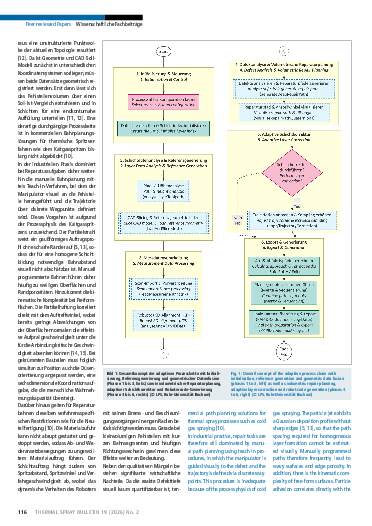
CSAM) is particularly well suited to the repair of high-value metallic components. To date, industrial implementation has frequently failed because of the handling of individual damage geometries: manual path programming is time-consuming and hardly reproducible, and an end-to-end coupling of measuring and manufacturing systems is lacking. Building on the path planning system developed in the IGF project 3D Add-CS, this contribution presents an automated “Scan-to-Print” process chain for sensor-based defect repair. The actual geometry of the defect is captured by fringe projection and matched with the CAD reference model using an iterative closest point algorithm, which allows the defect volume to be identified precisely. Two different adaptive path planning strategies – “onion slicing” for the layer-by-layer filling of deep defect volumes and a layer correction of surface unevenness – generate 5-axis robot paths from the detected defects, which are translated directly into executable RAPID code. Validation on three practical repair scenarios confirms the functionality of the process chain and demonstrates a high accuracy and reproducibility of the automated path generation.
Pages: 114 - 121
Order this article as a PDF for 8.00 Euro. Send us a short e-mail with your details.
An active subscription enables you to download articles or entire issues as PDF-files. If you already are a subscriber, please login. More information about the subscription